
Building Ftify: Jana’s Directory for the Products Indie Makers Ship
In this interview, we feature Jana, a software developer and indie maker from Toronto, Canada, and co-founder of Ftify, a directory where independent makers launch their SaaS products and mobile apps. Ftify went live in October 2026. Jana talks about why he built it, how it keeps rankings honest, the challenges of launching with no audience, and what he has learned in his first weeks of running a launch platform.
Interview with Jana, co-founder of Ftify
Please tell us about yourself
I’m Jana, a software developer and indie maker based in Toronto, Canada. I’ve spent years writing software, and these days I build and ship my own products.
I love building, and I spend a lot of time with other indie makers, especially people building with AI coding tools like Claude and Codex. Today one person can ship a real product in a weekend. Getting anyone to notice it is the hard part, and that’s the problem I wanted to work on.
I run Ftify with my co-founder Roudy.
What is Ftify?
Ftify is a directory of SaaS products and mobile apps from independent makers. You can browse by category, upvote the products you like, comment, and ask makers questions directly.
For makers, it’s a place to launch. You submit your product, pick a launch day, and on that day it goes live on Ftify where people can find it, try it and vote for it. Every listing gets its own page with screenshots, a description and a link to the product.
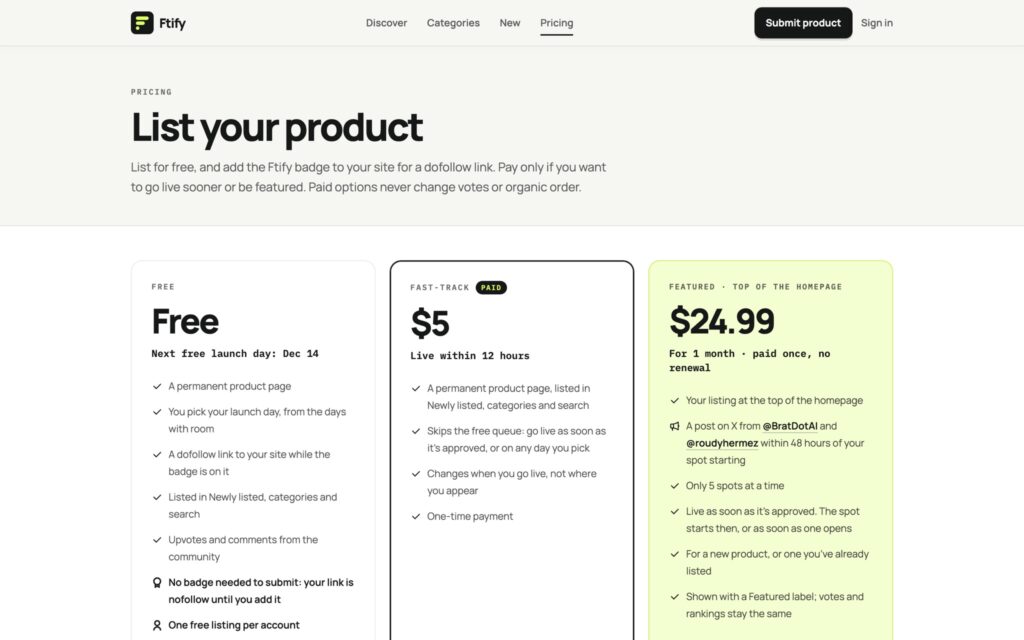
There are three ways to launch:
• Free: add a small “Listed on Ftify” badge to your website, and you can list one product for free. While the badge is on your site, your listing gets a followed (dofollow) link back to you.
• Fast-track: pay a small fee and go live as soon as you’re approved, instead of waiting for a free launch day.
• Featured: a clearly labeled spot on the homepage for 30 days.
We also built a set of free tools for makers: a launch checklist, a search and social preview checker, a robots.txt and sitemap check and more. You don’t need an account to use them.
How did you come up with this idea?
When you launch a product without an audience, you end up submitting it to dozens of directories. I did this myself, and it was frustrating. Many directories are full of products nobody has looked at in years. On others, you can’t tell which listings are there because they’re good and which are there because someone paid.
I wanted to build the directory I wished existed as a maker: easy to submit to, honest about what’s paid, and actually useful for the people browsing it.
What makes Ftify different from other launch platforms?
Our most important rule is that organic rankings are never for sale. Paying lets you go live sooner or get a labeled Featured spot. It never adds votes and never moves you up the organic list. Paid placements always say they’re paid.
We’re careful with links too. Paid listings get a sponsored link, because we’re not in the business of selling links. Free listings that show our badge get a followed link, and every week the top three free launches keep their followed link for good, even without the badge. So the best free products are rewarded for being good, not for paying.
We also keep launch days small. There are only five free launches a day, so each product gets a real chance to be seen instead of disappearing in a list of a hundred.
What were the problems you faced? How did you overcome them?
There have been quite a few.
Getting the first makers. A directory with no products is empty, and makers don’t want to launch on an empty directory. I posted about Ftify on X, messaged makers directly to invite them, and shared it in maker communities. Our free tools helped too: makers found them through search, used them to prepare their launch, and then discovered they could launch on Ftify as well.
Spam. As soon as Ftify went live, people tried to submit the same product many times from different email addresses. We tightened the rules so each maker gets one free listing, and we review every submission. Today listings are reviewed within 24 hours.
Balancing money and trust. A directory has to make money, but the moment paid listings look the same as free ones, people stop trusting it. That’s why paid spots are always labeled and organic rank is never sold.
Building alongside everything else. Ftify isn’t the only thing on my plate, so finding time to build was hard. I broke the work into small pieces and tried to ship something every day instead of waiting for a perfect free week.
Learning everything around the code. Writing the software was the part I knew. Setting up payments, getting emails delivered, running a live server and getting Google to find and index the site were all new to me. After launch, I found that only a handful of our pages were showing up in Google, so I had to learn how search indexing works and fix it step by step.
Marketing myself. As a developer, my instinct is to keep building and hope people show up. They don’t. I had to get comfortable posting about my own product on X, every day, without sounding like an ad. I’m still learning this one.
Tell us about an achievement you are most proud of
Our first paid customer. When someone you’ve never met decides your product is worth paying for, it changes how you see it. It stopped being my side project and became something makers rely on for their launch.
Launching at all is something I’m proud of too. Many people have ideas. Taking one all the way to a live product that real makers trust with their launch day is a different thing.
What are the future goals of Ftify?
In the near term, we’re working on:
• A weekly “Top launches” board, so the best products of the week get more attention.
• More free tools for makers getting ready to launch.
• Growing the community of people who come to Ftify to discover new products, not just makers listing them.
Long term, I want Ftify to be two things at once: the first place indie makers think of when they launch, and the place people visit to discover new tools and apps worth trying. Each one makes the other stronger. Makers come because there’s an audience, and the audience comes because there are great new products.
What advice would you give to makers launching their first product?
Don’t wait for an audience before you launch. Most makers start with zero followers, and that’s fine.
Get the boring basics right first: make sure sign-up works, test your payments, and check that your homepage clearly says what the product does and who it’s for. Then launch in a few sensible places, talk to every person who tries it, and keep going. One launch day won’t make your product, but ten real users who tell you what’s missing can.
And build in public. People like supporting makers they’ve watched grow.
Where can people find Ftify?
You can browse new launches and submit your own product at the Ftify website. You can follow me on X at @BratDotAI and Roudy at @roudyhermez


